

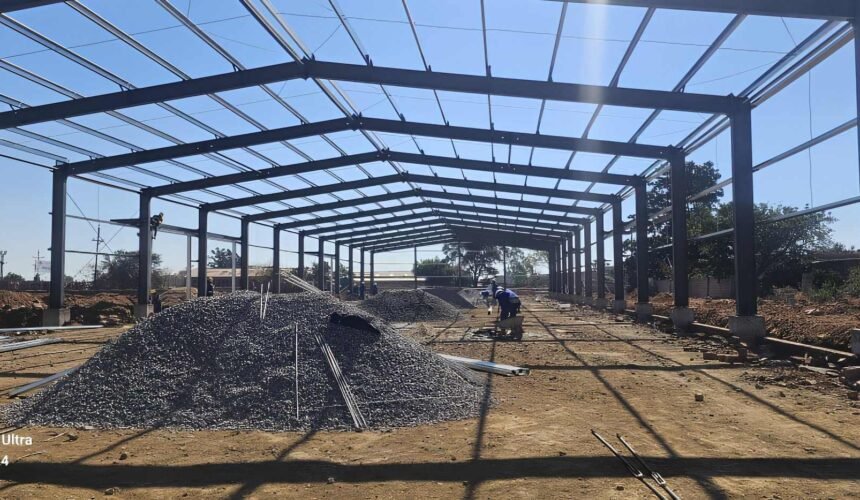
In the Zimbabwean engineering landscape, few phrases strike as much fear into the hearts of developers as “Black Cotton Soil.” Known scientifically as Vertisols, these dark, heavy clays are prevalent in regions like Bulawayo’s surrounding areas, parts of Mashonaland, and the Lowveld.
At Ncube Consults, we don’t view these soils as a deal-breaker—we view them as an engineering challenge that requires precision, data, and a departure from “business-as-usual” construction.
The Anatomy of a “Swell”: Why Black Cotton is Dangerous
The primary issue with Black Cotton soil is its high montmorillonite content. This mineral allows the soil to act like a powerful hydraulic jack.
The Expansion (Wet Season): As the summer rains hit, the clay particles absorb water and expand. This expansion can exert upward pressures exceeding 250 kPa—far more than the weight of a standard residential wall. This leads to “heave,” where the ground literally lifts the building.
The Contraction (Dry Season): During our long dry winters, the moisture evaporates, and the soil shrinks, creating deep, wide fissures. As the ground drops, the foundation loses its support, leading to “subsidence.”
Without specialized engineering, this seasonal “see-saw” motion creates the classic diagonal cracks in brickwork, jamming doors, and shattered floor tiles that plague many Zimbabwean suburbs.
The Forensic Approach: How We Diagnose the Site
Before we recommend a foundation, we perform a Structural & Geotechnical Assessment. We don’t just look at the surface; we look at the profile.
Trial Pits & Boreholes: We determine the “active zone”—the depth to which seasonal moisture changes affect the soil. In Zimbabwe, this can range from 1.5m to 3.0m deep.
Atterberg Limit Tests: We measure the plasticity index. This tells us exactly how “aggressive” the clay is and how much it will move.
Moisture Content Profiling: Understanding the current state of the soil allows us to predict future movement.
Engineered Solutions: Beyond the Strip Foundation
Traditional strip foundations (the most common type in Zimbabwe) are often a recipe for disaster in Black Cotton areas because they are too rigid and shallow. Here is how Ncube Consults engineers for stability:
1. Stiffened Raft Foundations (Waffle Slabs)
Instead of independent walls, we design a thick, reinforced concrete “raft” that sits under the entire building.
How it works: If the soil moves, the entire house moves as a single, rigid unit. Think of it like a boat on the ocean; the boat doesn’t crack just because the waves move up and down.
2. Piled Foundations & Ground Beams
For larger commercial structures or high-risk residential sites, we go deep.
The Strategy: We drill “piles” (concrete pillars) through the clay until they reach stable, non-expansive soil or bedrock. The house then sits on these pillars, completely isolated from the moving clay.
3. Soil Replacement & Moisture Barriers
Sometimes, the best solution is to remove the “enemy.” We excavate the clay and replace it with engineered, non-expansive fill (like G5 or G7 gravel) compacted in layers.
The “Apron” Strategy: We design wide concrete aprons around the building to ensure rainwater is shed far away from the foundation, keeping the moisture levels under the house constant year-round.
The “Ncube” Advice: Don’t Wait for the Crack
The cost of fixing a failed foundation is often three to five times higher than the cost of doing it right the first time.
If you are planning to build in an area known for dark, heavy soil, or if you’ve noticed “V-shaped” cracks in your existing property, you need more than a builder—you need a structural audit. We use BIM-driven design to simulate these soil pressures, ensuring that our designs are optimized for safety and cost-effectiveness.
At Ncube Consults, we make sure your vision is built on a foundation of facts, not just hope.
Need a Site Assessment?
Don’t gamble with the Zimbabwean geology. Contact our team in Bulawayo today for a comprehensive soil and structural consultation.





1 Comment
Yasuo Wind
July 28, 2025, at 4:51 pmI feel really great with this, it is really helpful